
Mission to Mars - Energy & Food
OPENING QUESTIONS: Please grab ~ 4 ft of butcher paper. Divide it into 5 sections of roughly the same size.
We'll use this as sort of a team notes document in preparation for our substantial Big 5 net/web project that we'll begin in class next Tuesday.
Please work with your team to make note of the various:
OBJECTIVE: I will evaluate various methods for generating energy for a human colony on Mars during today's class.
WORD FOR TODAY:
Please make a list of the electrical appliances/equipment you use in an average day:
- The appliance
- The purpose of that appliance
- The amount of time in fractions of hours that you use that device/appliance
═══════════════════════════
- The amount of power it consumes every second (we measure that in Watts). A hundred W light bulb requires 100 watts of power to run every second that it is turned on.
- Calculate the total power used (in Watt hours or Kilowatt hours) For example, if you you use a 1500 W hairdryer for 10 minutes you'd record (1500 W)(1/6 hr) = 250 W hours
═══════════════════════════
Now please work with your team to determine how much energy it will take to heat a somewhat smaller dome/personal habitat than we talked about yesterday-- we'll shrink it from a diameter of 10 meters (yesterday's luxury version) to a more practical 5 m diameter for today:
We'll further presume that our small dome is inside a sealed lava tube under the Martian surface so the temperature in the tube will be about -30 C (about 10 degrees F).
Use chatGpt to help you calculate how much electricity (in kilowatt hours) it will take to keep your little dome a "toasty" 62 degrees F.
═══════════════════════════
We'll work together on some rough calculations for the power required to grow food on Mars.
Where will that power come from?
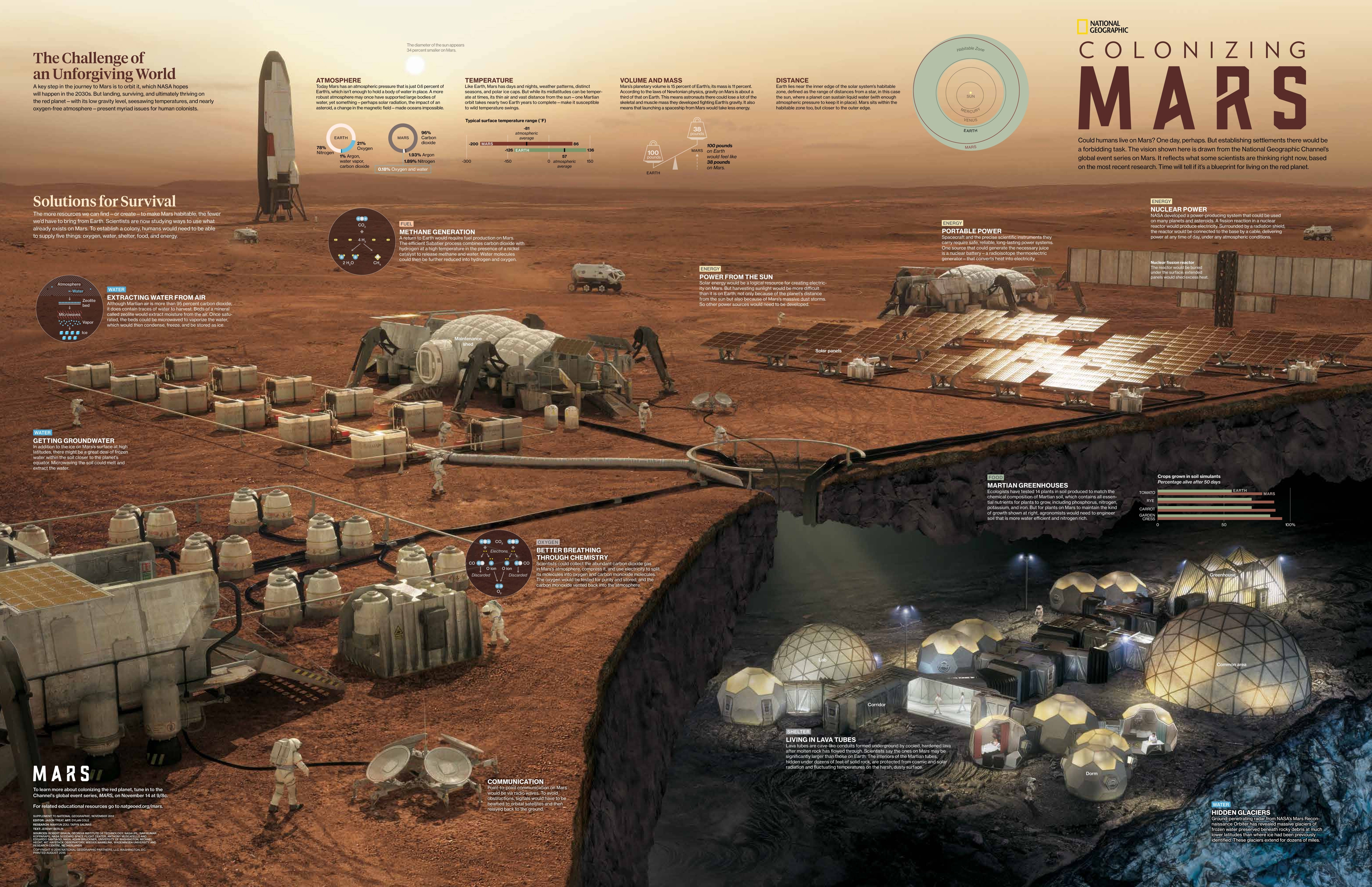
I used the wizard to create the following graphic. Let's say that there are 500 solar planels there.
I'll model the methodology for determining how much energy those panels can produce.

My Chatgpt solution is HERE
An intriguing workaround is to provide vats of algae. Algae is *really* good at feeding on waste and generating oxygen.
The bad news is we'd need 118 'regular' sized vats to do that.
Uh oh, anyone detecting a problem here?
Let's work on finding other ways to get air-- a number of our colleagues suggest using 'hydrolysis' to split water in to oxygen and hydrogen. Let's use the wizard to do some calcs on that. The basic chemical reaction is very well understood:
2H20 + electricity → 2H2 + O2
Using electricity we can break apart water such that for every two parts of water you get two parts of hydrogen gas and 1 part of oxygen gas.
Using the wizard I was able to show that 1.6 grams of water would yield 1 liter of oxygen gas.
From our previous work we see that two people need 588 liters of fresh oxygen to survive for 12 hours.
So... (588 liters Oxy) x (1.6g water/1 liter oxy) ~ 940 liters of water ~ 250 gallons of water.
OOOhhhhh... so how much energy would it take to do that?
The answer is ~ 2800 kw/hrs of electricity.
To put that in perspective that would take about 1800 high power hair dryers running for an hour to use up that much electricity!
It would take about 1600 solar panels collecting solar energy 10 hours a day on Mars to generate that much electricity..... uh oh
═══════════════════════════
Now let's start working on water requirements